
~Wandering the history of Koriyama City, Fukushima~ The beans and Mr. Gonsai【The Asakano Journey】
Sponsored Links
Issued in style Koriyama, vol. May 2016.
Wandering Through the History of Koriyama City, Fukushima
The Beans and Mr. Gonsai – The Asakano Journey
Some people say, “Koriyama has no remarkable history.” But that couldn’t be further from the truth.
With historic sites such as the Ōyasuba Kofun and the archaeological park, we know that people have lived here for hundreds of years, building communities and cultivating a rich local culture.
At Style Koriyama, we explore and share the many hidden charms of Koriyama City.
This time, we are proud to introduce one of Koriyama’s lesser-known great figures.
Who is Mr. Gonsai?

Our local favorite Japanese sweet shop, Kashiwaya, sells a dessert with an intriguing name: Gonsai Bean.
So, what exactly is “Gonsai”? Is it a type of bean? Or was it named after the person who created it?
Curious to find out, I bought one. It comes in charming, eye-catching packaging. On the back, I discovered that the name actually comes from a man called Asaka Gonsai, a Neo-Confucian scholar and educator who lived in the final years of the Tokugawa shogunate.
He had a deep love for mountains, and the character “Gon” in his name is associated with mountains. In the same way, he used a character meaning “mountain” when naming his private school.

His school produced many graduates who later became prominent figures in the final years of the Tokugawa shogunate, including Iwasaki Yataro, Takasugi Shinsaku, Yoshida Shoin, Maejima Hisoka, and Oguri Kozukenosuke.
Did you know that Koriyama was home to such a remarkable figure as Gonsai?
Wanting to learn more about him, I visited Asakakunitsuko Shrine, the place where Mr. Gonsai was born.
Mr. Gonsai had about 2,280 pupils
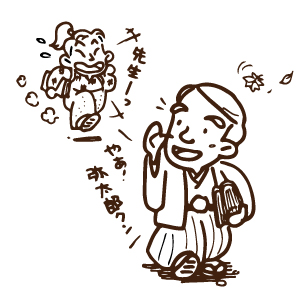
Teacher! Hey Yataro.
“Koriyama was one of the most prosperous post towns along the Oshu Road. As a hub of travel and exchange, it became a place where literature and haiku culture flourished. Perhaps it was this rich cultural environment that shaped a person like Mr. Gonsai.”
Born at Asakakunitsuko Shrine, Gonsai devoted himself primarily to Neo-Confucianism, a philosophy grounded in rational thought. However, he valued flexibility and equality, and was open to adopting positive ideas from other schools of thought.
His educational philosophy focused on drawing out each student’s individuality and abilities, rather than imposing his own ideas on them. He believed that anyone who tries to standardize individuals is not qualified to be a teacher.
Later, he became a professor at Shoheizaka Gakumonjo, the highest educational institution in Japan at the time. How impressive is that?
Among his many students was Iwasaki Yataro from Kochi, the founder of Mitsubishi. Yataro stayed at Gonsai’s home and studied under him more closely than most other students.
Out of deep gratitude for the support he received, Yataro later established facilities related to Mitsubishi in Koriyama—some of which are still operating today.
Gonsaizm is still being succeeded today
What Kind of Person Was He?
Who was the real Gonsai?
Beyond being a respected scholar, he was also a devoted father of five children. He would sometimes take them all the way to the hot springs of Kusatsu to treat their skin conditions.
Although he held a high academic position, he was known for his warm personality. He had many friends, built strong personal connections, and treated people with genuine kindness.
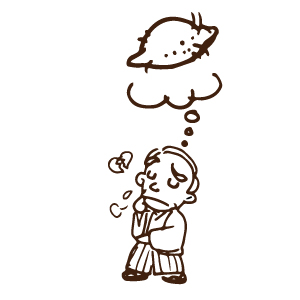
There is even a humorous story about him: he avoided eating potatoes because he did not want to pass gas during his lectures. That small detail shows how considerate he was—even about the comfort of his students!
Another well-known story highlights his habit of praising others. Gonsai believed deeply in encouragement. Whenever a student composed a poem, he would always find something to praise.
If the poem itself was not very good, he praised the handwriting.
If both the poem and the handwriting were lacking, he praised the quality of the paper or the brush.
In those days in Japan, this kind of positive, praise-based education was extremely rare. Yet Gonsai consistently chose encouragement over criticism.
He was also a man of integrity who offered his opinions on politics and foreign diplomacy to the Tokugawa shogunate. His students, inspired by the encouragement of such a great mentor, grew highly motivated and went on to become active in many different fields.
It is easy to understand why he was so respected—and even loved. I find myself wishing I could have met him.
Today, Asaka Kindergarten continues to care for children in the spirit of his educational philosophy, carrying on his tradition of nurturing individuality with warmth and encouragement.
His kindness was shaped by his own experiences. As a young man, he traveled alone to Edo (present-day Tokyo) without financial support and lived as a boarding student in his teacher’s home. Those hardships likely deepened his empathy and strengthened his character.
What a remarkable person.
I wanted to share a bit of “Gonsaism” with you.
And finally, here is a quote from Gonsai:
“If you become lazy halfway through, you lose everything you have worked for and return to being unskilled.”
In other words, if you give up before finishing, all your previous effort may be wasted. The message is simple but powerful: stay committed, and see things through to the end without losing focus.
What a wise and timeless lesson.

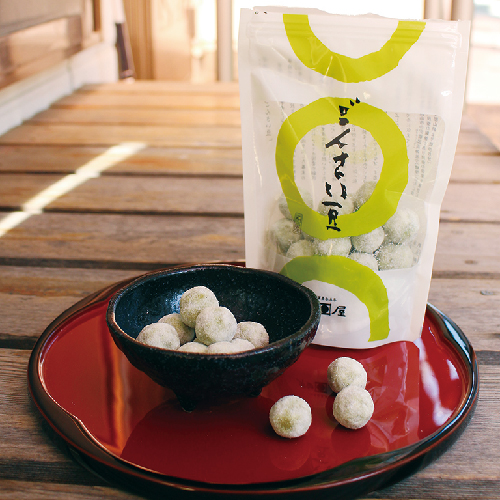
① “Gonsai Bean”
The origin of this sweet comes from an old story.
At the age of 17, Gonsai set his sights on becoming a scholar and set off for Edo (present-day Tokyo). During his journey, he was eating roasted soybeans when a thought crossed his mind: “I wish these beans were mixed with sugar.”
That simple idea is said to have inspired what we now know as Gonsai Bean.
The sweet has a gentle toasted soybean flour flavor, with a mild and refined taste. It’s simple, elegant, and quietly memorable—much like the man himself.
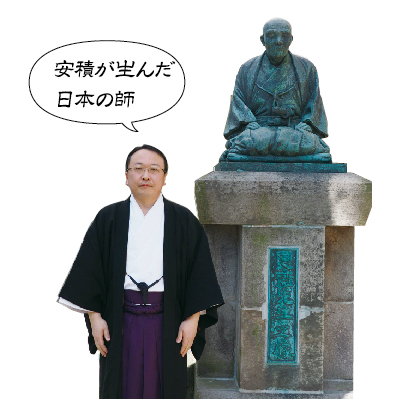
② The Teacher of Japan from Asaka
“It is nonsense to say that Koriyama has no meaningful history,” says Tomoshige Ando, the 64th chief priest of Asakakunitsuko Shrine.
Having researched his ancestor Gonsai in depth, and drawing on his extensive knowledge of Koriyama’s history, Mr. Ando has written a book titled Introduction to the History of Asaka.
I spoke with Mr. Ando about Gonsai’s educational philosophy and his personal character.
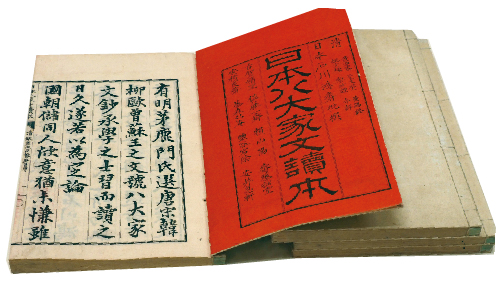
③ Gonsai Memorial Hall
At the Gonsai Memorial Hall, visitors can see books written by Gonsai himself, including original manuscripts in his own handwriting.
Seeing his brushstrokes up close offers a rare and personal glimpse into the life and mind of this remarkable scholar.
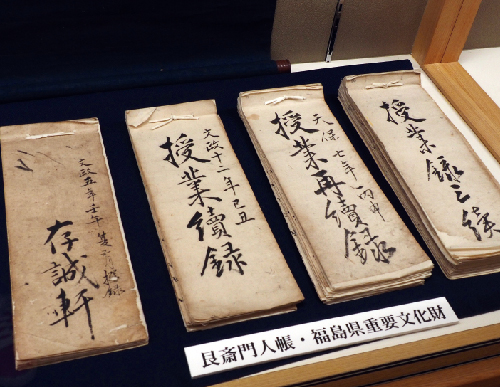
④ Gonsai’s Pupil Register
Gonsai’s Pupil Register contains the names of 2,280 students who studied under him.
This remarkable document has been designated as an Important Cultural Property by Fukushima Prefecture, recognizing its historical significance and the lasting impact of his educational legacy.
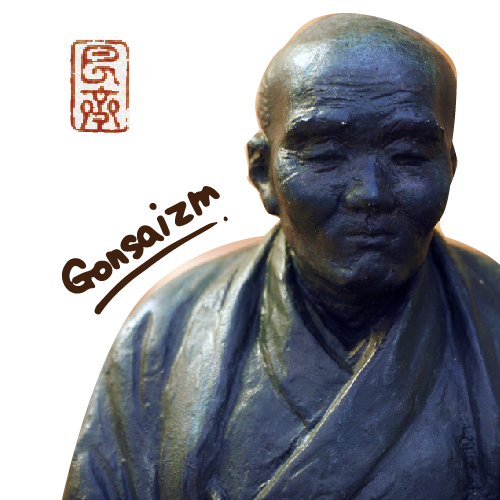
⑤ One of the Eight Great Masters of Japan
Gonsai is recognized as one of the Eight Great Masters of Japan, standing alongside distinguished scholars such as Rai Sanyo.
Being counted among such renowned intellectuals highlights the level of respect and influence he held in the world of scholarship.
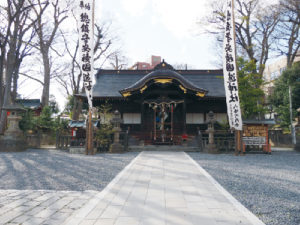
Interview
Tomoshige Ando
64th Chief Priest of Asakakunitsuko Shrine
Asaka Gonsai Memorial Hall
(Located within Asakakunitsuko Shrine)
1-6-23 Shimizudai, Koriyama City, Fukushima Prefecture
Tel: +81-24-932-1145
Right after the starting point of a mountain ascent on Sakura Street. The white torii|(front guard frame) is the sign↓
Sponsored Links