
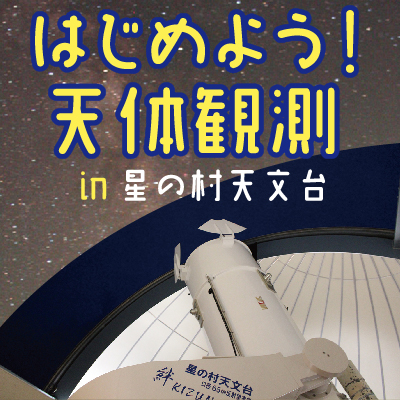
Why not trying to stargaze at Hoshinomura Observatory?
Sponsored Links
The Milky Way Galaxy, the Summer Triangle, Mars, Saturn, meteor showers, etc.
Why not looking up at the sky sometimes?
“Hoshinomura Observatory” in Takinemachi, Tamura City, is famous for its beautiful view of stars. Here are the stories about stars and the universe from the interview.
Tips for Easy Stargazing
★To tell the truth, you can stargaze from anywhere, even in town or your house!
Look for a dark place with less or little light. You can see large and eye-catching ones, such as the Summer Triangle or first magnitude stars! It would be fun to try to find your favorite spots for stargazing around your neighborhood ♪
★Better to practice your telescope during the day time
It is actually difficult to aim a telescope at a star with one try. So, practicing during the day time will make it easier to observe at night by pinpointing a remote landmark like a tall building. When you try at night, the eye-catching moon or a bright fixed star would be a good target to start with.
TOP3 FAQs about Stars
Q. Can we see the Milky Way?
A. “Yes. Actually, you can see it in Tamura city. But most people don’t know they are actually seeing the Milky Way because it looks hazy like a cloud. If you see it from our observatory, it looks larger and clearer.”
Q. What is good about stargazing?
A. “It is full of discoveries, fun, and impressions. When the sky is clear, you can see many stars from the observatory, even the stars you can’t normally see, and they are too many to pick one to watch.”
Q. Do you think aliens exist?
A.“Yes, they might. There are countless galaxies and planets in the universe that we have not found yet. It might be possible that any creatures exist in there.”
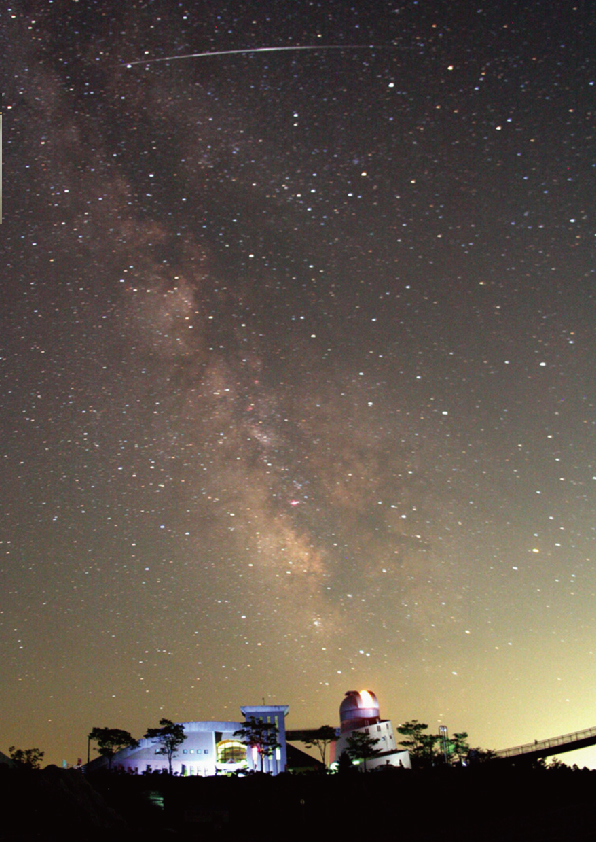
Hoshinomura Observatory and the night sky
What is the Summer Triangle?
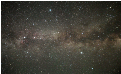
The Summer Triangle is a big long skinny triangle-shaped asterism that connects three stars: Vega/Lyra, Altair/Aquila, and Cygnus/Deneb. In an old Japanese tale, Tanabata, Vega and Altair are the lovers called “Orihime” and “Hikoboshi”.
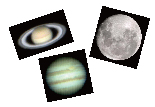
Photos of Moon and planets taken at the Observatory

An aerosiderite (iron meteorite). You can actually touch it.

You can try the fossil rock hunting activity! What is going to come out? So exciting!
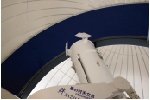
An astronomical telescope with a caliber of 65 centimeters (about 25 inches), which is largest in Fukushima! The light condensing rate is 8600 times higher than that of when you look at stars with naked eyes. They say you can see a tennis ball 20 kilometers (about 12 miles) away.
★★★
At this Observatory, staffs seemed very nice and friendly tell us everything we want to know. It was such a healing moment thinking of the universe. This is definitely the place you can enjoy beautiful stars in Fukushima. You can also visit and learn for kids summer project!
Tomohiro Ohno, Vice Director of Hoshinomura Observatory
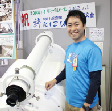
“Summer is good for stargazing in terms of temperature. In Fukushima, the air is so clear that you can see stars really well.”
Interview Cooperation by Hoshinomura Observatory
Tel:0247-78-3638
Address: 60-1, Aza Nukatsuka, Kamimata, Takinemachi, Tamura City, Fukushima
*Open everyday during August.
Closed Days: Tuesdays
Open Hours: 10:00am-5:00pm (1st April-30th September)
10:00am-4:00pm (1st October-31st March)

Article from the August 2016 Issue
Sponsored Links