
【Rugby World Cup 2015】The return of the Rugby’s legend! The tackle interview with Hitoshi Ohno, from Mihota-machi, Koriyama City,Fukushima.
Sponsored Links
Issued in the Style Koriyama, vol. December 2015.
The Style Koriyama’s special interview
The Return of a Rugby Legend!
An exclusive, hard-hitting interview with Hitoshi Ohno from Mihota-machi, Koriyama City, Fukushima.

Japan’s national rugby team stunned the nation—and the world—with their remarkable performance at the 2015 Rugby World Cup. The match between Japan and South Africa has been hailed by many fans as one of the greatest moments in Rugby World Cup history.
Today, we are honored to welcome one of the key players behind that unforgettable team, Hitoshi Ohno, as our special guest for this interview.
Q: Mr. Ohno, why do you think Team Japan performed so well this time?
I believe it was because we trained harder than anyone else in the world. During our training camp in Miyazaki in June, the workload was almost unbelievable. We started early in the morning and trained three times a day. By the end of each session, when I wrung out my jersey, sweat would literally pour from it.
In real matches, even a small mistake in judgment can lead to a loss. So we intentionally trained under extremely tough conditions to learn how to stay calm and make clear decisions. I think that preparation truly paid off.
Our scrum also became one of our greatest strengths. In the match against South Africa, we secured solid scrums and maintained possession, which ultimately led to the winning points.
Q: The match against South Africa ended in a historic victory. How were you feeling during the game?
During the game, I was focused on one thing only—winning. That was all I had in my mind.
It was a back-and-forth battle: when they scored, we answered right back. We truly believed that as long as we kept possession of the ball, victory would be ours.
Q: How did you start playing rugby?
I played baseball until I graduated from high school. Then a friend of mine who was in the rugby club at Nihon University passionately encouraged me to join. One day, I went to the rugby field to check it out, and I immediately felt the team’s incredible atmosphere. I knew I wanted to be part of it. That’s how my rugby journey began.
Q: Rugby is a very tough sport. What is the appeal and real thrill of rugby for you?
On the rugby field, you get to do things you would never normally do—like tackling your opponent or driving forward while carrying the ball against intense pressure. It pushes you beyond the ordinary. That raw physicality, combined with teamwork and strategy, is what makes rugby so thrilling and special to me.
Q: Do you have any pre-game routines?
I used to shave my beard before every game, but these days I don’t have any particular routine. Instead, I focus on sharpening my concentration and getting mentally prepared for the match.
Q: What do you enjoy doing after training or on your days off?
I do enjoy going out for drinks. After the World Cup, I had the chance to share a few drinks with the teammates I had spent four years with. It was an unforgettable time and truly special for all of us.
Q: What is your goal?
My goal is to once again represent Japan at the 2019 Rugby World Cup in Tokyo.
Rugby has gained a lot of attention in Japan in recent years, and I’m truly grateful for that. I hope we can sustain this momentum—not just as a passing trend, but as a lasting part of our culture.
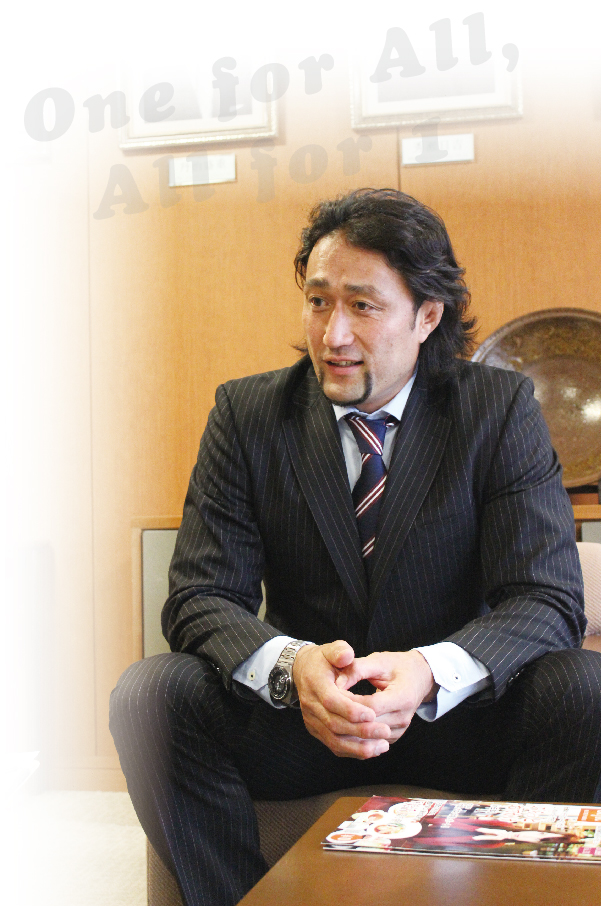
Q: What is your message to the children in Fukushima who play rugby—or dream of becoming rugby players?
Rugby is a sport where everyone can make the most of their own unique strengths. There are many different positions, so you don’t have to be the fastest runner or the best at kicking or passing. There’s a place for everyone.
If you’re even a little interested, I encourage you to come to a rugby field and pick up an oval ball.
I know the situation in Fukushima is still not easy, but the energy of children can be shared with the world as the energy of Fukushima itself. I hope rugby brings smiles to many faces. And to those of you already playing, tell your friends how fun rugby really is.
Q: Please share a message for the local people.
Thank you all for your continued support. When I returned in August before the tournament, I saw the temporary housing near Big Palette Fukushima, and it reminded me that Fukushima is still on its path to recovery. That’s why I wanted to encourage everyone through our performance on the field.
For the 2019 Rugby World Cup, Koriyama and Iwaki could serve as training camp locations. During the World Cup in England, I was deeply moved by the warm welcome we received everywhere we went. Fukushima also has wonderful food and incredibly kind people. I truly believe the people here offer outstanding hospitality.
If a training camp is held in Fukushima, I hope we can count on your support. Together, let’s show the world just how amazing Fukushima really is.
After the interview
Thank you very much, Mr. Ohno, for taking the time to speak with us despite your busy schedule.
He was a true gentleman, and above all, he had an unmistakable presence. When he shook my hand with his large, powerful grip, I could feel his strength and sincerity. With his charismatic personality and warm smile, he left a lasting impression on us.
Let’s continue to support Hitoshi Ohno and Japan’s national team as they strive for even greater success!
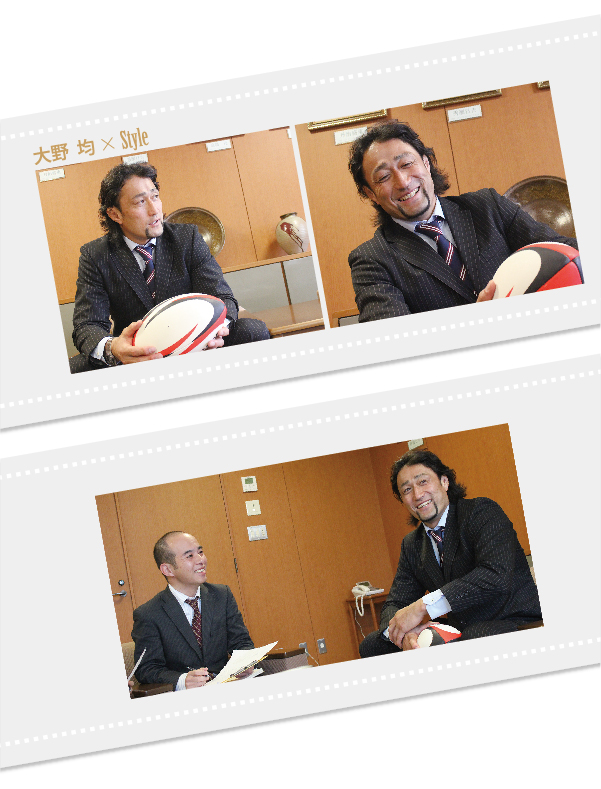
Profile
Hitoshi Ohno
Born May 6, 1978 (age 37)
Height: 196 cm / Weight: 105 kg
From Mihota-machi, Koriyama City, Fukushima
Education:
Koriyama Municipal Mihota Junior High School
Fukushima Prefectural Seiryojoho High School
College of Engineering, Nihon University
Career:
Joined Toshiba Corporation
Holds the record for the most caps in the history of Japan’s national rugby team
(A “cap” refers to an appearance in an international match against another national team.)
Position: Lock (LO)
Nickname: Kin
Favorite words / Motto: “The ashes still burn.”
About Mr. Ohno’s Childhood
A story shared by the vice president of his fan club
What kind of child was Mr. Ohno?
Kin-chan was an exceptionally kind boy. He never fought or bullied anyone. As the eldest of four siblings, he helped his parents with household chores and even delivered newspapers. He was also an excellent student and served as a student representative in high school.
His parents are dairy farmers, so he drank milk three times a day—and he was already quite big as a child. Many people thought he would stay in his hometown and help with the family business. However, he started playing rugby at university, which opened the door to his career as a professional player and eventually led him to join Toshiba. His family fully supported his decision.
Rugby is a sport that demands a strong fighting spirit, and at times his natural kindness may have seemed like a disadvantage. But through dedication and hard work, he overcame those challenges. He truly proved that hard work pays off.
Interview: Fukushima Prefecture Rugby Football Association
Shooting location: Koriyama City Hall
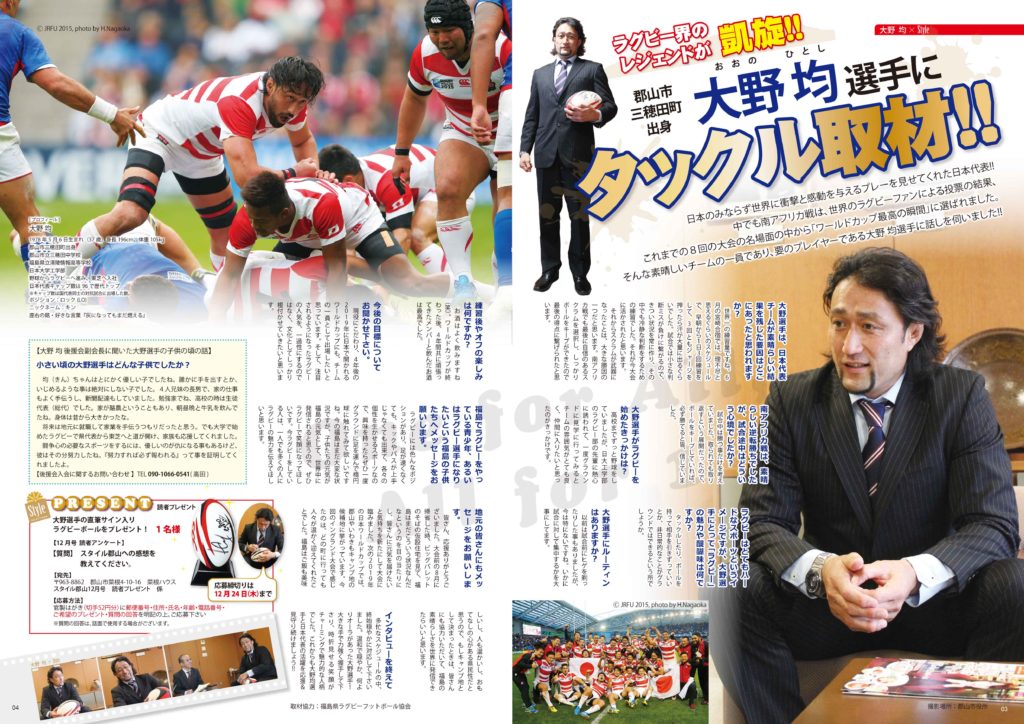
The double-page featuring Hitoshi Ohno
※Currently we do not accept the present application.
Sponsored Links