Interview via Online: Fukushima’s Famous Actor and Entertainer, Nasubi Active in Various Fields
Story Told by Locked-Up Survivor, Nasubi,
From Super Long Online Interview Presented by Style KORIYAMA
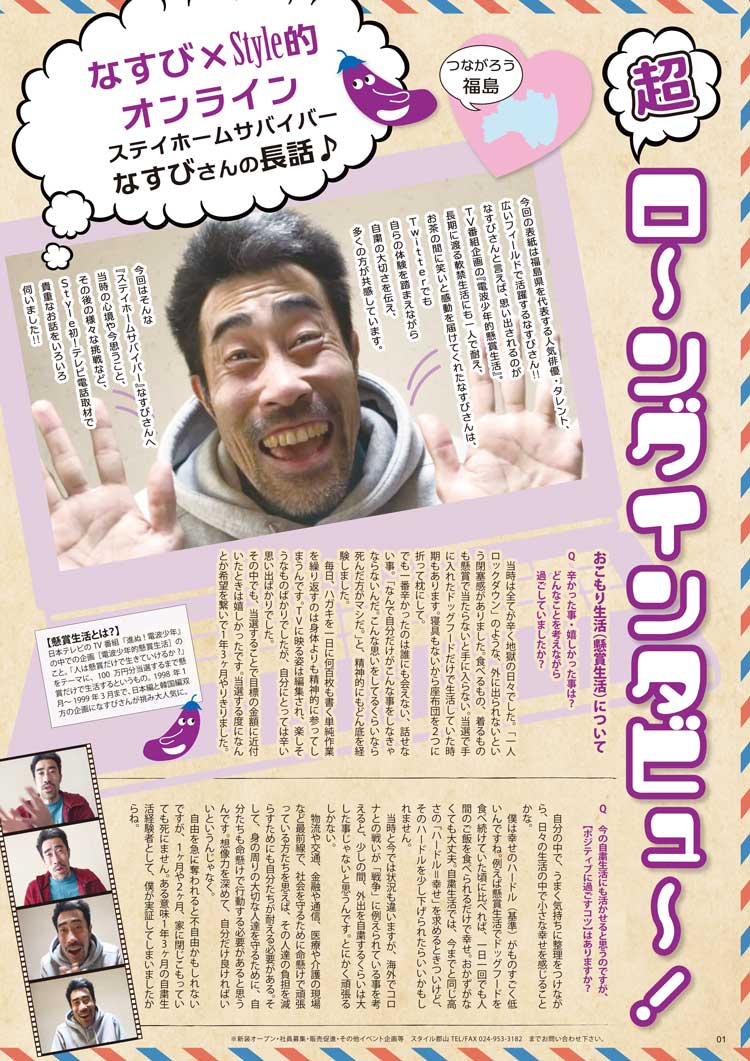
When many Japanese people hear the name “Nasubi,” they immediately think of the unforgettable segment Denpa Shonen-teki Kensho Seikatsu from a popular reality show.
Enduring months alone in a small apartment, forbidden to leave, he brought laughter to audiences while also touching their hearts.
When stay-at-home requests were issued during the COVID-19 pandemic, Nasubi took to Twitter to share messages about the importance of staying home, drawing on his own experience. His words resonated deeply with many people.
In this interview, we spoke with “Lockdown Survivor” Mr. Nasubi about his thoughts—then and now—and the many challenges he faced after the show.
What follows is his heartfelt story, shared with us in our very first video-call interview.
What is Denpa Shonen-teki Kensho Seikatsu?
It was one of the segments of the reality show Susunu! Denpa Shonen, broadcast on Nippon Television in Japan from January 1998 to March 1999.
Under the project’s theme, “Is It Possible to Live Only on Sweepstakes Prizes?”, he attempted to survive solely on items he won, continuing until the total value of the prizes reached 1 million yen.
The project consisted of two parts—one set in Japan and another in Korea—, and it made him immensely popular.
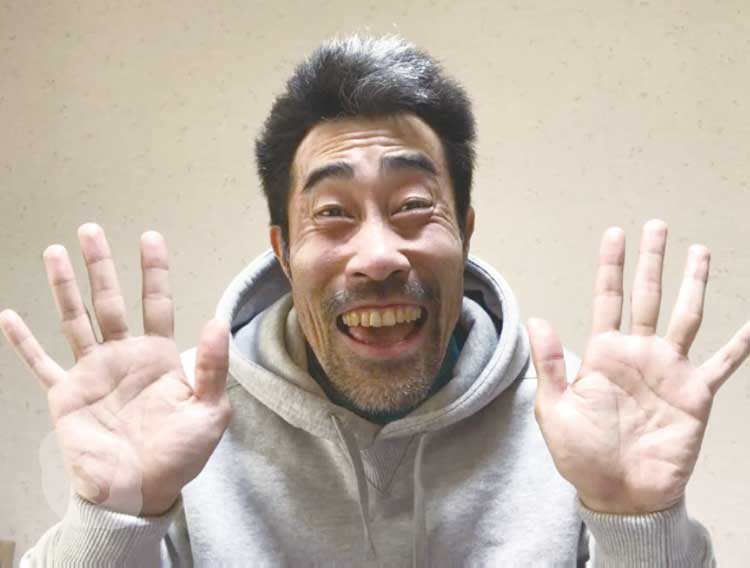
Life of Being Locked Up: Sweepstake Days
Q. What were harsh or made you happy? What were you thinking at that time?
Everything was harsh, and every day felt like hell. It was similar to today’s “lockdown,” except I was completely alone—and under constant pressure, knowing I wasn’t allowed to step outside.
I couldn’t get food or clothes unless I won them through sweepstakes. For a while, the only thing I had to eat was dog food I had received as a prize. There was no bedding provided either, so I folded a zabuton cushion in half and used it as a pillow.
But the hardest part was not being able to see or speak to anyone. My mental state was at its worst. I kept thinking, “Why me? Why do I have to go through all of this? I’d rather die than keep feeling this way.”
Every day was the same: writing hundreds of postcards. It drained me mentally more than physically. Although the edited show often made it seem as if I was having fun, my reality was filled with pain.
Still, there were moments of hope. Each time I won a prize, it felt like a small light in the darkness. That hope kept me going for one year and three months.
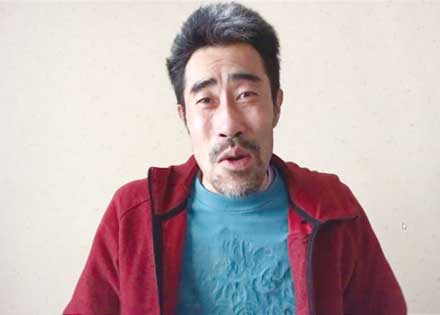
Q. As a piece of wisdom for the current stay-home situation in Japan, would you give us a tip “How to stay positive”?
For me, it means finding small pieces of happiness in everyday life while learning to manage my emotions.
My standard for happiness is quite low. Compared to the days when I had to eat dog food from sweepstakes prizes, I now feel grateful just to have one proper meal a day. It doesn’t even need side dishes.
In the current stay-at-home situation, many people may be struggling because they can’t maintain their usual “standard of happiness.” Lowering that standard, even just a little, might help.
Of course, today’s situation is different from what I experienced two decades ago. But considering that the fight against the coronavirus has been described in some countries as a kind of war, giving up going out for a while is not such a big sacrifice. We simply need to endure.
When we think about the people working tirelessly on the front lines—those in medical and nursing care, financial and IT services, logistics, and transportation—who are supporting and protecting our society, we need to be patient in order to reduce their burden.
And I believe we must act responsibly to protect the people around us. We need to be more thoughtful—not thinking, “As long as I’m fine, that’s all that matters.”
Being suddenly deprived of freedom is frustrating, and many people must feel overwhelmed by the inconvenience. But staying at home for one or two months will not kill you.
In a way, I proved that by surviving one year and three months in confinement.
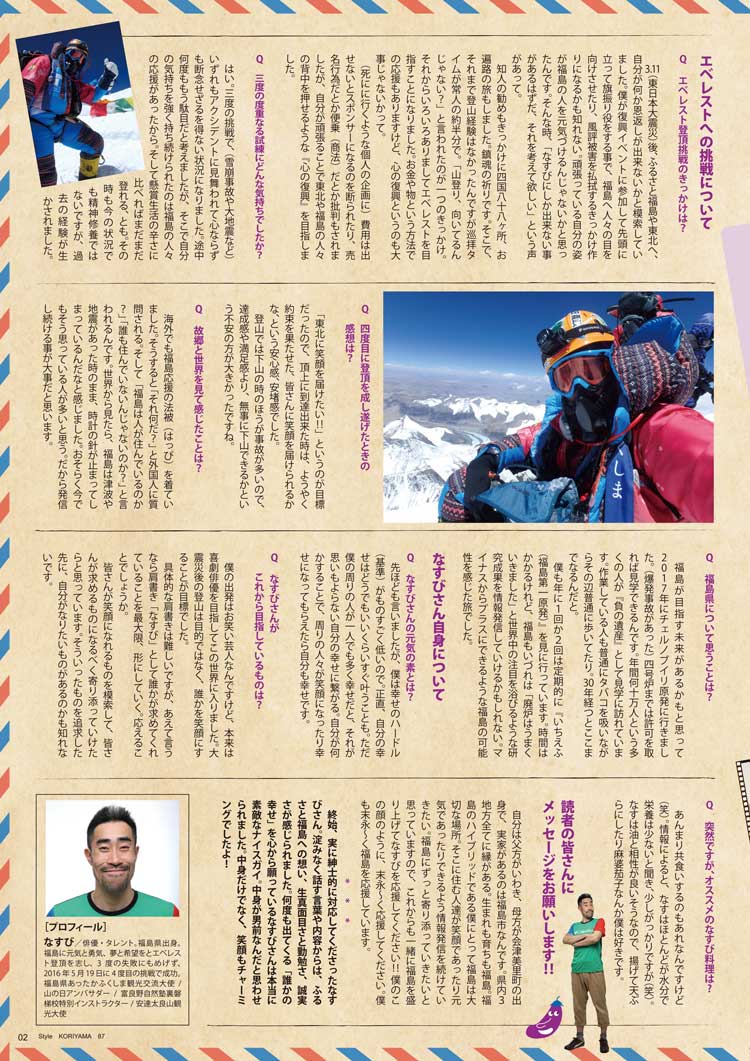
Challenge to Mt. Everest
Q. What made you climb Mt. Everest?
After 3.11—the Great East Japan Earthquake and Tsunami in 2011—I wanted to find a way to give back to my home prefecture of Fukushima, and to Tohoku as a whole.
I thought that by participating in reconstruction events and taking on a visible role, I might help draw attention to Fukushima and perhaps ease the damage caused by harmful rumors. I also hoped that if people in Fukushima saw me doing my best, it might give them strength.
It was around that time that someone told me, “There must be something only you can do. That’s what you should search for.”
I was also encouraged to take on a spiritual journey—the Ohenro pilgrimage—visiting the 88 temples of Shikoku. Despite having no experience in mountaineering or trekking, I completed the pilgrimage in nearly half the usual time. After that, someone said to me again, “You might actually be good at climbing mountains.” That became one of the reasons I decided to take on Mount Everest.
Various events followed, and eventually I made up my mind to aim for the summit. I believed that mental recovery was just as important as financial and physical support in the aftermath of disaster.
There were times when I was denied sponsorship because it was a personal challenge and carried the risk of losing one’s life. I was also criticized by some who said I was seeking fame or exploiting the situation.
But I kept moving forward. I wanted to contribute to “mental restoration”—to encourage people in Fukushima and across Tohoku by showing them what it means to keep trying.
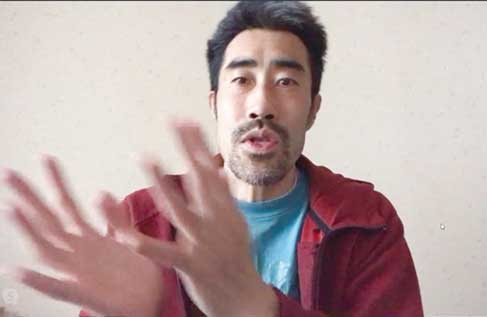
Q. How did you feel when you faced a difficult situation three times?
Yes, we tried three times. Each time, accidents such as avalanches and earthquakes occurred, and we were forced to abandon our plans. There were many moments when I thought it was over.
But thanks to the support of the people of Fukushima, I was able to stay strong. Eventually, I found myself thinking that I could endure even more—especially compared to the harsh days of the sweepstakes challenge.
It might be an exaggeration to say that climbing Everest—or even the current COVID-19 situation—is a form of mental training. But my past experiences have certainly helped me a great deal.
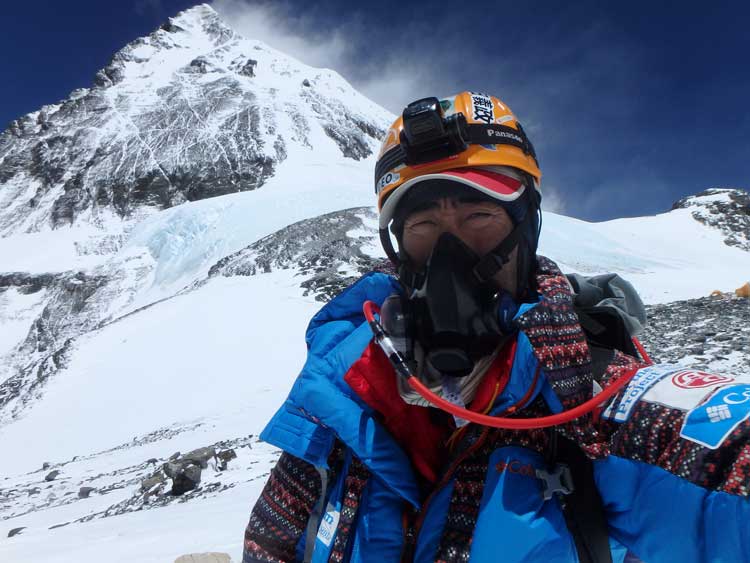
Q. What did you think when you succeeded to climb to the top for the fourth challenge?
Since my goal was “to bring smiles to the people of Tohoku,” when I reached the summit, I felt a deep sense of relief that I had finally fulfilled my promise. I hoped that, in some way, I had been able to make them smile.
However, mountaineering accidents happen more frequently on the descent. So rather than feeling accomplished or satisfied, I was more concerned about whether we would be able to make it down safely.
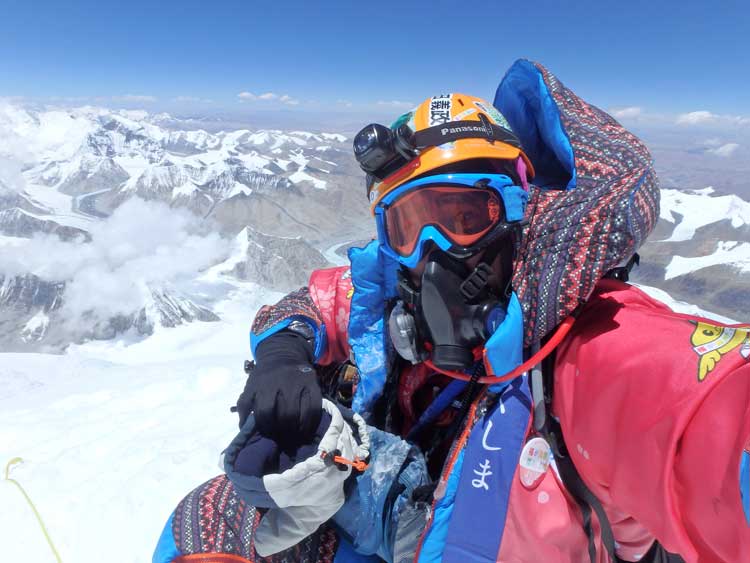
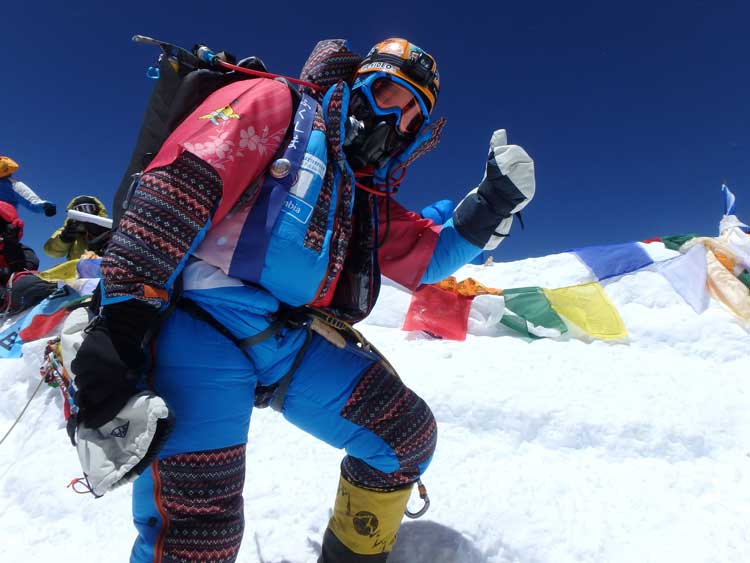
Q. What did you feel about your hometown and the world after going abroad?
Even outside Japan, I continued to wear a traditional Japanese happi coat as a symbol of my support for Fukushima.
Some people overseas would ask me, “What is that?” And then they would say things like, “Do people still live in Fukushima?” or even, “No one lives there anymore, right?”
Hearing that made me realize that, for many people outside Japan, time in Fukushima seemed to have stopped at the moment of the earthquake and tsunami. I believe there are still many people abroad who see it that way.
That is why I feel we must continue sharing our message with the world.
Q. What come to your mind about Fukushima?
In 2017, I visited the Chernobyl Nuclear Power Plant, hoping I might find some clues about the future Fukushima could aspire to. With official permission, tourists are allowed to visit the site of Unit 4, which exploded in the accident. Hundreds of thousands of people come each year to see what is often described as a “negative legacy.”
What struck me most was seeing workers walking around—even smoking cigarettes—as if it were an ordinary place. It made me realize how much can change over the course of three decades.
I also visit “1F” (Fukushima Daiichi Nuclear Power Plant) regularly, about once or twice a year. Through these visits, I have come to believe that Fukushima has the potential to transform the world’s perception—from something negative into something positive.
It will take time. But perhaps Fukushima can one day successfully complete the decommissioning of the plant and share the knowledge and lessons gained with the world. If that happens, it could once again draw global attention—this time for hope and progress.
Mr. Nasubi’s Personal Activity
Q. What is your driving force?
Like I said, my standard for happiness is very low, so I can actually be happy over the smallest things.
But when more people around me are happy, that often brings me unexpected joy as well. If something I do can make the people around me smile, that alone makes me happy.
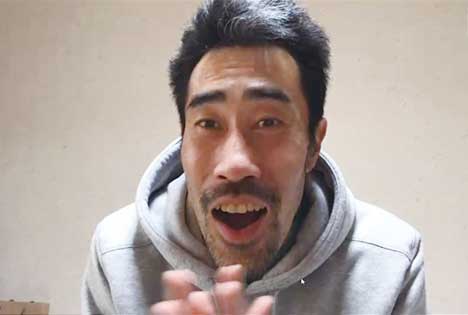
Q. What is your goal from now on?
I began my career as a comedian, though I originally entered the entertainment industry hoping to become a comedic actor.
After the Great East Japan Earthquake, my decision to climb Mount Everest was never really about mountaineering itself. My goal was simply to bring a smile to someone’s face.
It’s difficult to define my career in a single word. But if I had to, I would say it’s about making things happen—about doing my best to live up to what people expect of “Nasubi” as much as I can.
I want to stay as close as possible to what people hope for from me by constantly searching for ways to bring smiles to as many people as I can.
Perhaps who I truly am will reveal itself after I have fully devoted myself to that pursuit.
Q. By the way, which Nasubi (eggplant) dish do you recommend?
I’m not so sure about eating my family, haha.
But I’ve heard that eggplant is mostly water and not very high in nutrients, which is kind of a shame. Still, I’ve also heard that eggplant pairs really well with oil, so…
If you ask me, I’d recommend eggplant tempura or stir-fried eggplant with chili sauce.
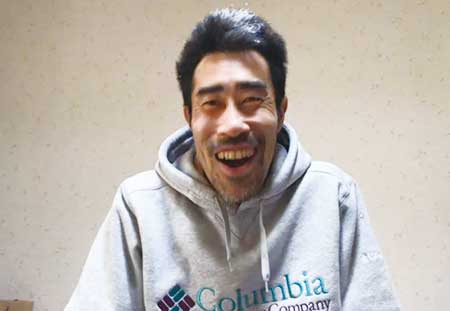
Would you say a few words to our readers?
I was born and raised in Fukushima Prefecture, and I feel connected to all three regions of the prefecture—my father is from Iwaki, my mother is from Aizu-Misato Town, and I grew up in Fukushima City.
Because my roots are spread across each area, Fukushima means everything to me.
To everyone living in this prefecture, I want to continue sharing messages that bring smiles and encouragement. I want to stay close to Fukushima, always.
So let’s bring more energy to Fukushima together. I truly appreciate your continued support.
And if possible, I hope for support as long-lasting as my (rather long) face.
I will continue supporting Fukushima for as long as I can.
Throughout our interview, Mr. Nasubi was the perfect gentleman. In the way he spoke and in the substance of his words, we could clearly sense his deep love for Fukushima, as well as his sincerity, diligence, and integrity.
As he mentioned many times, what he truly wishes for is “someone else’s happiness.”
He is a genuinely kind person with a remarkable character—and a truly charming smile.
Biography
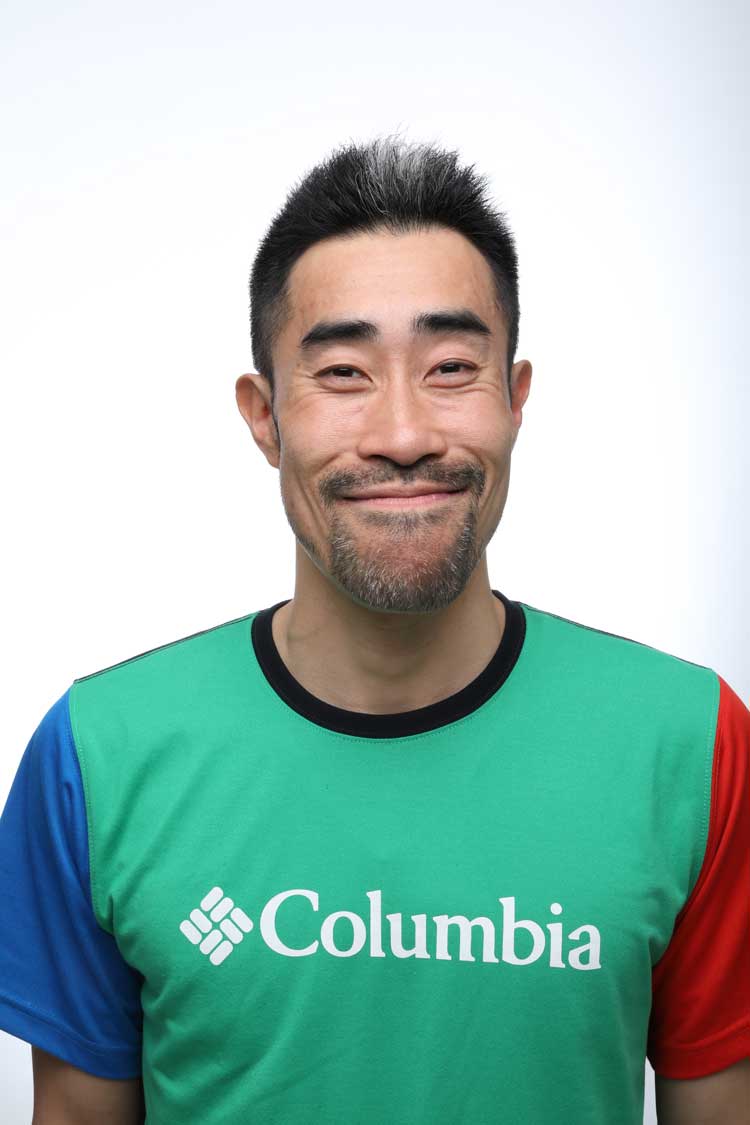
Nasubi is an actor and entertainer from Fukushima Prefecture, Japan.
In an effort to energize and encourage the people of Fukushima—and to bring them dreams and hope—he set his sights on summiting Mount Everest. After being forced to turn back three times, he finally succeeded on his fourth attempt, reaching the summit on May 19, 2016.
He currently serves as the Ambassador for Attaka Fukushima Tourism Exchange (Fukushima Prefecture), Ambassador for Mountain Day (a Japanese national holiday), Special Instructor at the Urabandai School of Furano Shizen Juku, and Ambassador for Mt. Adatara Tourism.
Posted on Style KORIYAMA July Issue